
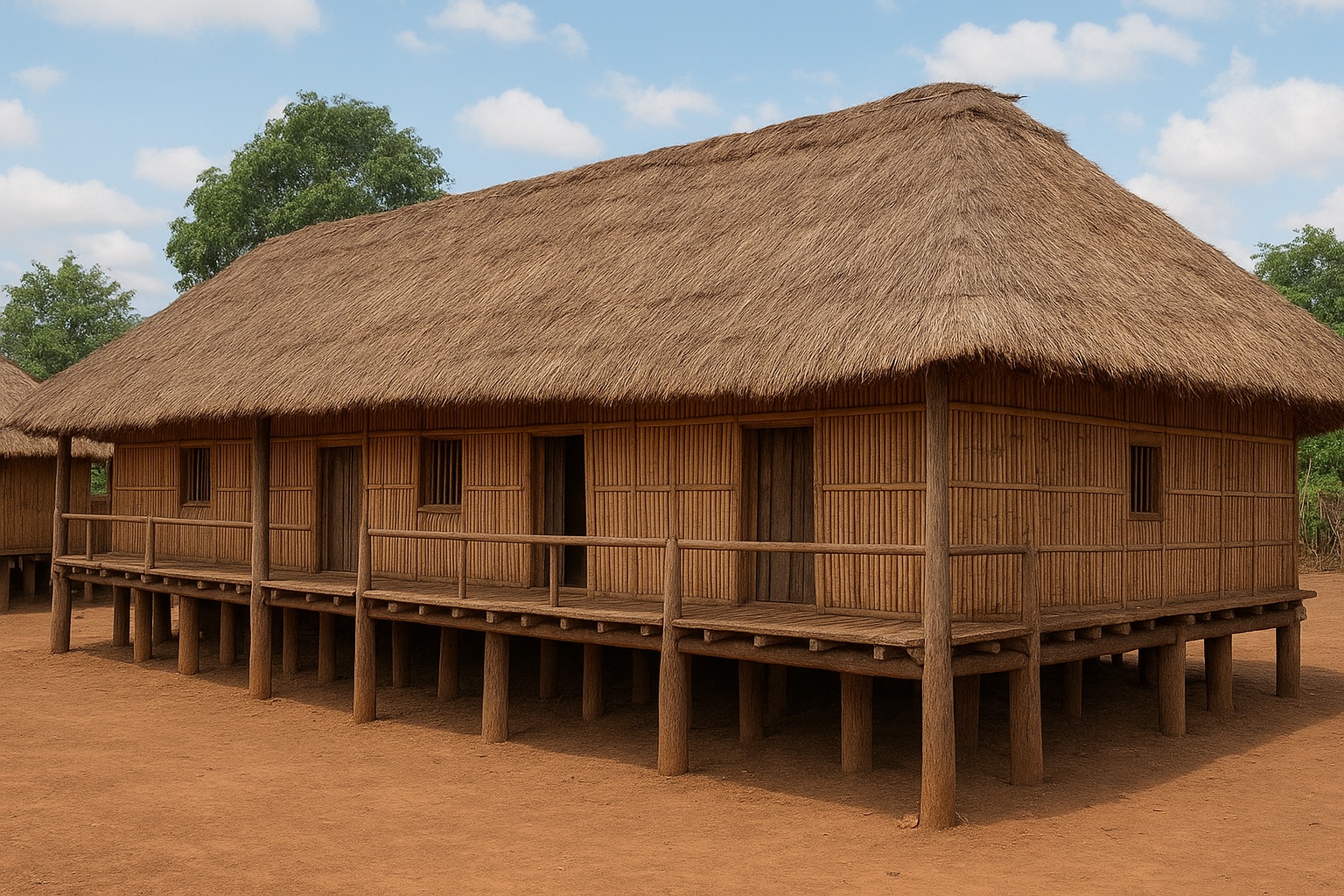
The Nokpante — often described as the traditional Garo bachelor dormitory — is one of the strongest cultural symbols of the Garo community. For generations, it served as a training ground, a learning centre, a community shelter, and a place where Garo boys transformed into responsible young men. Although earlier days every Garo village had its own dormitory, today its presence has reduced dramatically. Now, the traditional Garo dormitory is mostly preserved in culturally protected villages or showcased at the Garo Heritage Village (Wangala A’dam, Chibragre). Learn more about Culture here.
Growing up Garo, I spent many childhood days in the cultural dormitory with friends and elders. Even though my early life did not belong to the old Songsarek era, stories from grandparents and memories of my visits shaped how I understand its importance in Garo culture.
What Is the Nokpante?
The dormitory functioned as:
- a training centre for young boys
- a hub of Garo traditions and teachings
- a cultural school for discipline and responsibility
- a defence shelter during emergencies
- a gathering home for unmarried boys
In essence, the Nokpante dormitory shaped the cultural backbone of Garo manhood.. Today, it still symbolizes strength, unity, cultural discipline, and the heritage of the Garo people.
Nokpante in the Songsarek Era
During the Songsarek era — when Garos followed indigenous animistic beliefs — each village had its own dormitory. It was usually built:
- at the centre of the village
- near the Nokma’s house
- using timber, bamboo, palm leaves, and traditional ropes
The structure represented youth unity, cultural discipline, and collective community strength. Learn more about traditional Garo villages on Meghalaya Tourism.
Roles of the Dormitory
Training Ground: Boys learned hunting, fishing, wrestling, trapping, and survival skills.
Cultural School: Elders taught stories, traditions, rituals, songs, and oral history.
Moral Discipline: Boys learned respect, unity, courage, and responsibility.
Community Defence: Youth stayed alert to protect the village during emergencies.
Preparation for Manhood: Skills learned here shaped them into future husbands, farmers, warriors, and community pillars.
Elders often said that a boy who spent time in the dormitory carried the strength of the village within him.
Modern Era Changes
With the introduction of Christianity, formal education, and migration, the Nokpante traditional Garo dormitory’s declined. Yet, during my childhood visits, I still had the chance to sit inside a traditional Garo dormitory, talk with older boys, hear stories, laugh, and learn.
How the Dormitory Changed Over Time
- Many villages stopped using it as a dormitory
- Some became informal meeting houses
- Some remained as cultural symbols
- Many disappeared entirely
Today, surviving structures exist mainly in:
- Culturally preserved villages
- Garo Heritage Village
- Tourism-based heritage sites India Tourism
Structure and Architecture
Traditional Nokpante dormitories were large, strong houses built with community effort. Boys helped construct and maintain them, learning teamwork.
Materials: bamboo, timber, palm leaves (tok), thatch, cane binding (rikgitang), mud or wooden flooring
Fireplace & Sleeping Arrangement: central fireplace, platforms along walls, storage for tools, drums, and traps
Skills Learned
Cultural Skills: traditional songs, stories, dance rhythms, festival preparation (Wangala Festival)
Survival Skills: hunting, fishing, farming, jungle navigation, building tools
Moral Values: discipline, sharing, loyalty, respect
Social Responsibility: protection of the village, supporting festivals, helping elders
Dormitory and Garo Festivals
During the Wangala Festival, youth in the Nokpante:
- prepared drums (Dama)
- practiced dance steps
- guarded and organized festivities
- supported ritual activities
Even today, surviving dormitories are busiest during festival season.
Decline Reasons
- Nuclear family shift
- Formal schools
- Modernization & migration
- Christianity & lifestyle changes
- Lack of youth participation
- Village expansion
Where to See the Dormitory Today
- Culturally preserved Garo villages
- Garo Heritage Village
- Remote Songsarek communities in Meghalaya, Assam & Bangladesh
- Tourism-based heritage villages (India Tourism)
Why It Still Matters
Represents: Garo identity, cultural discipline, youth unity, ancestral wisdom, community strength, heritage preservation.
Even if the original function reduced, its cultural meaning continues.
Conclusion
The dormitory remains a strong symbol of Garo tradition — shaping boys into men and preserving community bonds. Preserving it keeps the spirit of Garo culture alive.
Visit our Culture section to explore more heritage content.
FAQ: Nokpante (Traditional Garo Bachelor House)
Q1. What is the dormitory?
A traditional Garo bachelor house where boys lived, trained, and learned cultural values.
Q2. Did every village have one?
Yes, in the Songsarek era, almost every village had such a dormitory.
Q3. Does it still exist?
A few survive in preserved villages and Garo Heritage Village.
Q4. What did boys learn?
Hunting, farming, traditions, discipline, stories, songs, survival skills, and social responsibility.
Q5. Why did it decline?
Modern education, migration, Christianity, lifestyle changes, and nuclear family trends.