Starting a business often begins with curiosity, motivation, or the desire for independence. Many people search for business ideas hoping to find a clear direction. However, ideas alone do not guarantee stability. What matters is understanding how an idea fits into real life, how it survives challenges, and how it grows slowly through discipline, learning, and consistent effort.
This guide is written with realism and responsibility. It avoids hype, shortcuts, or exaggerated claims. Instead, it explains how entrepreneurship works in real conditions, where progress may be slow, mistakes are common, and patience becomes a valuable strength. By reading this, entrepreneurs can gain practical insights that go beyond simple lists of ideas.
Understanding the Role of Business Ideas in Real Life
Every venture starts with a thought, but not every concept turns into a sustainable operation. A plan becomes meaningful only when it connects with a genuine need and can function under real constraints such as time, money, skills, and market conditions.
In practice, many ventures begin in modest ways:
- Offering a service to a small local audience
- Turning a personal skill into paid work
- Creating solutions for common daily problems
What separates progress from stagnation is not brilliance, but alignment. When a concept matches the entrepreneur’s capacity and the customer’s expectations, it has room to grow.
Why Early Struggles Are Normal and Expected
Most new ventures experience resistance in the beginning. Sales may be inconsistent, visibility may be low, and confidence may fluctuate. These early challenges are not signs of failure; they are part of the adjustment phase.
According to statistics, about 20% of small businesses fail within the first year, and roughly 65% fail within ten years, mainly due to poor planning or inconsistent execution. These numbers reinforce the importance of patience, careful strategy, and continuous improvement.
Common difficulties include:
- Limited customer awareness
- Unclear positioning
- Trial-and-error pricing
- Time management pressure
Instead of immediate results, this phase offers something more valuable: feedback. Those who observe carefully and adjust patiently often gain insights that shape long-term stability.
Generating Business Ideas: Practical Techniques
While many entrepreneurs wait for inspiration, actionable techniques can reliably produce concepts:
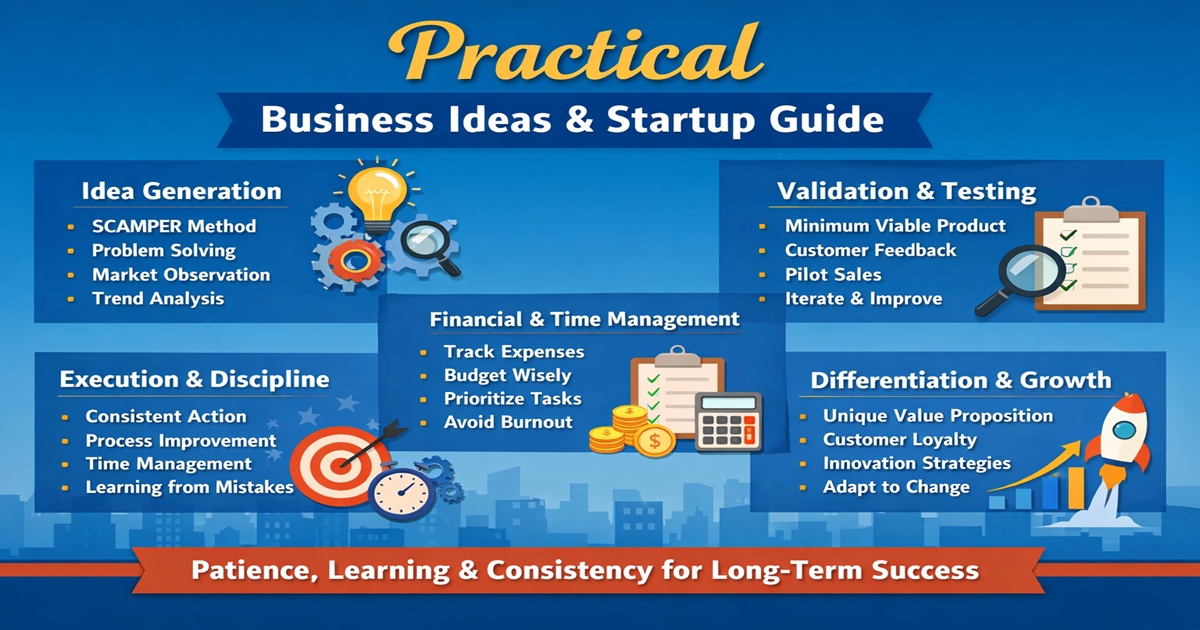
- SCAMPER Method – Modify, Combine, Substitute, Adapt, Put to another use, Eliminate, Reverse. Apply these to existing products/services to find new opportunities.
- Problem-Solving Approach – List daily frustrations and ask: “Can this be solved for money?”
- Skills & Passion Matching – Identify personal skills, hobbies, and professional experience, then brainstorm ways to monetize them.
- Market Observation – Look for gaps in local or online markets. Ask: “What do competitors fail to deliver?”
- Trend Analysis – Follow emerging industries like AI services, sustainability products, and wellness services, and consider entering early with a unique angle.
Using these strategies, your business ideas are more likely to translate into practical opportunities.
Validating and Testing Your Business Concepts
Even strong ideas can fail without validation. Simple testing reduces risk:
- Minimum Viable Product (MVP): Launch a small, stripped-down version to gauge interest.
- Customer Feedback: Collect responses through surveys, polls, or social media engagement.
- Pilot Sales or Pre-Orders: Test demand by offering limited availability before full-scale launch.
- Iterative Improvements: Refine based on early responses, not assumptions.
Validation ensures that your business ideas are practical and market-ready before significant investment.
Categories of Startup Ideas with Real Examples
Understanding types of ventures helps narrow focus. Examples:
- Service-Based Ventures: Cleaning, tutoring, consulting, delivery services
- Product-Based Ventures: Handmade crafts, tech gadgets, eco-friendly goods
- Online/Digital Ventures: Content creation, e-commerce stores, digital tools
- Niche Markets: Vegan products, pet services, elderly care solutions
- Tech-Enabled Startups: Mobile apps, software solutions, AI tools
- Franchise & Licensing: Proven business models requiring less trial and error
Practical and Popular Venture Ideas to Explore
Service-Based Ventures
- Home cleaning services
- Tutoring and coaching
- Freelance graphic design
- Social media management
- Virtual assistant services
- Pet grooming and pet care
- Event planning and management
Product-Based Ventures
- Handmade crafts and jewelry
- Organic or eco-friendly products
- Customized merchandise and gifts
- Tech accessories like phone cases and smart devices
- Health and wellness products
Online/Digital Ventures
- Blogging or content creation
- YouTube or podcast channels
- E-commerce store selling niche products
- Dropshipping and print-on-demand
- Online courses or digital workshops
- Mobile app development services
Niche and Trending Ventures
- Subscription box services (food, wellness, or lifestyle)
- Sustainable products for home or office
- AI-powered services or consulting
- Virtual fitness coaching or wellness services
- Remote work support tools and software
Franchises and Licensing
- Food kiosks or small cafes
- Mini-grocery or convenience stores
- Educational franchising (tutoring or activity centers)
- Fitness or wellness studios
Emerging Ideas
- Eco-friendly packaging solutions
- Elderly care services and home support
- Specialty delivery services (local foods, groceries, or gifts)
These business ideas cater to multiple investment ranges, skills, and market demands. By carefully evaluating which fits your expertise and environment, you can transform an idea into a sustainable venture.
Execution and Daily Discipline
Ideas gain value only through action. Execution transforms planning into learning and effort into experience. Many entrepreneurs underestimate how much attention execution needs. Incorporating concepts into daily operations ensures they are consistently evaluated and improved.
Effective execution includes:
- Showing up consistently
- Delivering what is promised
- Learning from mistakes
- Improving processes gradually
Many ventures succeed not because the concept was perfect, but because the execution was steady. Small improvements repeated over time often outperform dramatic but inconsistent effort.
Differentiating Your Entrepreneurial Concepts
To stand out in competitive markets, differentiation is key:
- Unique Value Proposition (UVP): Identify what makes your offer better or different.
- Superior Customer Experience: Faster response, personalized service, reliable quality.
- Innovation on Delivery: Using new platforms, subscription models, or flexible services.
- Combining Concepts: Merge ideas from different sectors (e.g., a wellness cafe offering coworking space).
Even simple differentiation strategies make your ventures more appealing and viable.
Frameworks to Evaluate and Choose Opportunities
Structured decision-making strengthens your chance of success:
- SWOT Analysis: Examine Strengths, Weaknesses, Opportunities, Threats.
- Feasibility Assessment: Consider startup costs, skills required, market size, and scalability.
- Risk vs Reward Chart: Rank ventures by potential impact and probability of success.
- Impact vs Effort Grid: Prioritize opportunities that are high-impact but manageable.
Using frameworks turns abstract concepts into clear, actionable business ideas.
Managing Slow Growth Without Losing Direction
Growth rarely follows a straight or predictable path. There may be periods where progress feels invisible. During such times, frustration can tempt people to quit prematurely.
Constructive ways to handle slow growth include:
- Refining quality rather than chasing scale
- Listening carefully to customer feedback
- Strengthening operational efficiency
- Improving communication and clarity
Reviewing and refining your business ideas can reveal hidden opportunities and prepare you for sustainable growth.
Financial Awareness as a Survival Skill
Financial discipline is essential, especially in early stages. Many promising ventures struggle due to poor money management rather than lack of demand.
Healthy financial habits include:
- Recording all income and expenses
- Separating personal and operational finances
- Avoiding unnecessary commitments
- Reinvesting carefully and conservatively
Clear financial awareness helps entrepreneurs make calm decisions during uncertain times.
Time Management and Prioritization
Entrepreneurs often juggle multiple responsibilities. Time management ensures effort is focused on tasks that actually drive progress.
Practical strategies include:
- Scheduling critical tasks first
- Delegating where possible
- Minimizing distractions
- Breaking large goals into smaller, actionable steps
Efficient use of time increases productivity without adding stress.
Mental Strength and Resilience
Running a venture is mentally demanding. Doubt, pressure, and comparison with others can weaken motivation if not managed properly.
Mental strength develops through:
- Accepting uncertainty as normal
- Maintaining realistic expectations
- Creating balanced daily routines
- Allowing time for rest and reflection
A stable mindset supports better judgment and long-term consistency.
Adapting to Market and Environmental Changes
Markets are not static. Technology, customer preferences, and economic conditions evolve continuously. Flexibility allows ventures to remain relevant.
Adaptation may involve:
- Modifying delivery methods
- Updating pricing structures
- Improving customer experience
- Learning new tools or skills
Adaptation does not mean abandoning purpose. It means refining approach while staying aligned with core values.
Building Trust Through Daily Actions
Trust is built gradually through everyday behavior. Customers return when they feel respected, heard, and treated fairly.
Trust grows through:
- Honest communication
- Reliable delivery
- Clear expectations
- Ethical conduct
A reputation built on trust often leads to organic growth through referrals and repeat engagement.
Learning as an Ongoing Responsibility
Learning is not optional in entrepreneurship. Markets change, tools evolve, and customer expectations shift.
Learning sources include:
- Customer conversations
- Industry observation
- Mistake analysis
- Mentorship and education
Those who remain open to learning adapt more effectively over time.
Ethics and Reputation
Entrepreneurs who prioritize integrity often gain long-term advantages. Ethics influence customer perception, employee loyalty, and peer respect.
Practical ethical practices include:
- Transparent pricing
- Honesty in communication
- Delivering on promises
- Following local regulations
Ethical conduct enhances credibility and reduces potential legal or reputational risks.
Customer Retention vs Acquisition
Many guides focus only on acquiring customers. Equally important is retaining existing ones. Repeated engagement reduces marketing costs and builds consistent revenue.
Retention strategies:
- Providing ongoing support
- Listening to feedback
- Offering small improvements
- Recognizing loyal customers
Understanding both acquisition and retention improves operational efficiency.
Support Systems
Entrepreneurs do not need to operate in isolation. Support systems can reduce avoidable mistakes and provide guidance.
Support may come from:
- Experienced mentors
- Peer communities
- Educational platforms
- Official resources
For structured guidance related to entrepreneurship and formal registration, individuals can explore:
- How to Manage Personal Finances Effectively
- Business Ideas for Retired Persons
- Startup India – Official government platform for planning, registering, and funding startups.
- Udyam Registration (MSME India) – Official portal for MSME registration and support.
Improving Instead of Restarting
Not every challenge requires starting over. Often, improvement is enough.
Improvement involves:
- Adjusting processes
- Clarifying communication
- Strengthening consistency
- Learning from feedback
Incremental progress builds resilience and confidence.
Frequently Asked Questions (FAQs)
1. Which small business requires low investment but has good potential?
Some service-based and online ventures need minimal capital to start. Examples include tutoring, freelance services, content creation, dropshipping, virtual assistance, and handmade crafts.
2. How can I test a business ideas without spending a lot of money?
You can validate an idea by creating a Minimum Viable Product (MVP), offering pre-orders, conducting surveys, or testing on a small audience.
3. Can I start a business without prior experience?
Yes. Learning happens through action, observing results, adjusting processes, and staying consistent.
4. How do I know if my business idea is viable?
Evaluate your idea using SWOT Analysis, Feasibility Assessment, and Risk vs Reward charts. Test early and collect feedback.
5. How long does it take for a new business to become stable?
Stability often comes from consistent execution, learning from mistakes, and adapting to market changes. Many ventures take months or years.
6. Are AI-based business ideas suitable for beginners?
Yes, many AI-powered services, such as chatbots or content automation, can be started with basic skills and proper guidance.
7. Can I make money from an online business quickly?
Quick profits are rare. Consistent effort, audience building, and learning digital marketing are essential.
8. How can sustainable or eco-friendly businesses succeed?
Target conscious consumers, offer unique eco-products or services, and emphasize transparency. Examples: eco-packaging, organic products.
9. Do I need a formal business registration to start a small venture?
Formal registration (like Udyam/MSME or GST) helps with legal protection, credibility, and access to government schemes.
10. How do I choose between multiple business ideas?
Compare ideas by skills, market demand, investment, scalability, and potential risks. Use frameworks like SWOT, Feasibility Assessment, and Impact vs Effort grids.
Conclusion
Entrepreneurship is a long journey shaped by patience, learning, and discipline. Business ideas play an important role, but they are only the starting point. Sustainable progress comes from consistency, thoughtful adaptation, and the ability to continue even when results are slow. Those who remain focused during difficult periods give themselves the strongest chance to grow steadily and responsibly.