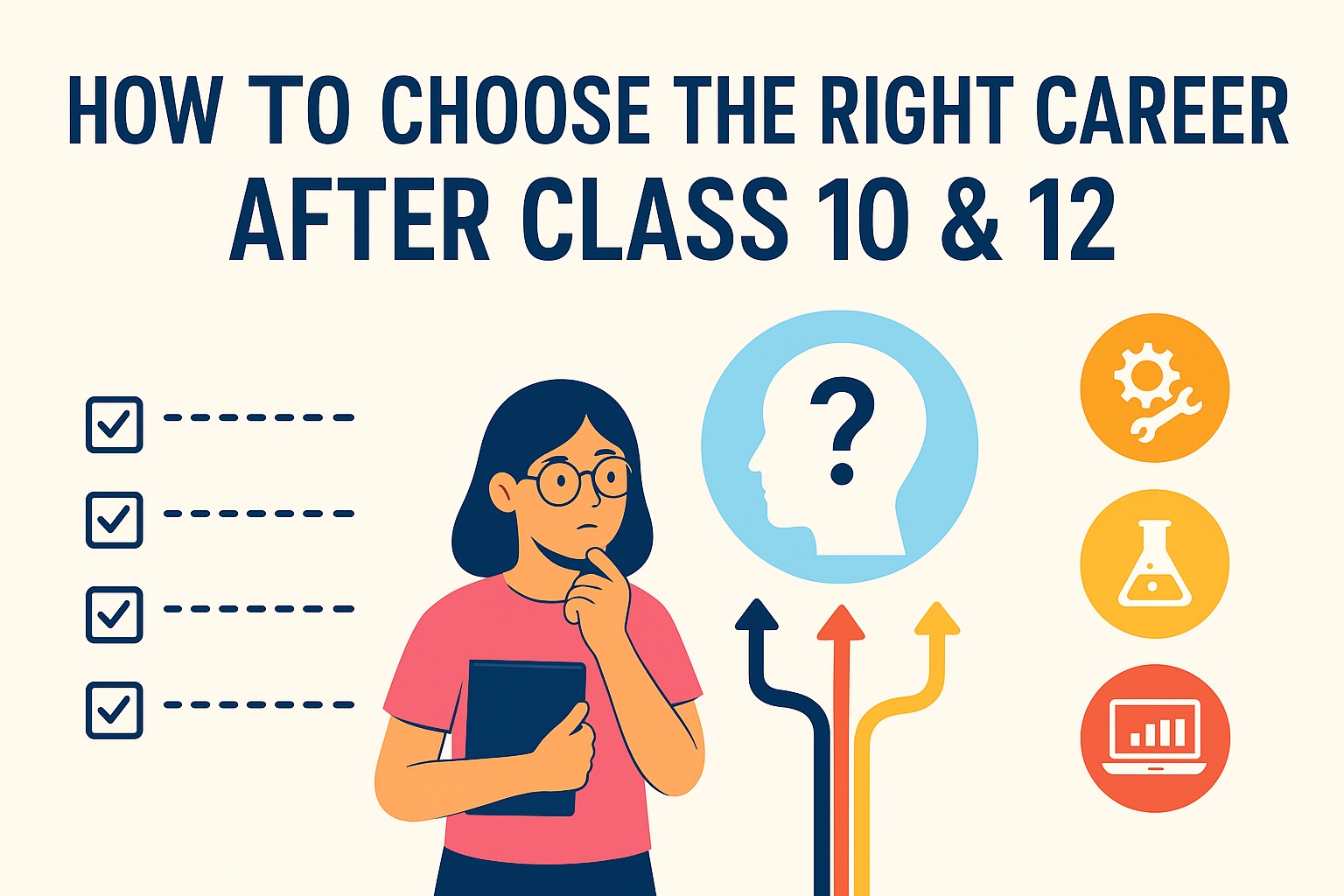
Choosing the right career after Class 10 and 12 is one of the most important decisions a student can make. The right choice not only shapes your future but also impacts your job satisfaction, personal growth, and long-term success.
In this guide, you’ll discover how to choose the right career after Class 10 and 12, practical steps to assess your interests and skills, explore popular and emerging career options, and plan for a successful future. For more guidance, visit our Education category.
Why Choosing the Right Career After Class 10 and 12 Matters
Many students make the mistake of picking a career based on peer pressure, parental expectations, or social trends. The reality is:
- Interest and passion matter more than popularity
- Skills and strengths determine long-term success
- Job opportunities and growth potential ensure financial stability
By understanding yourself and exploring career options, you can make a choice that balances passion, aptitude, and future prospects.
Example: A student who loves designing but chooses a general stream may struggle later, whereas pursuing graphic design or animation after Class 12 aligns interest with career growth. Knowing how to choose the right career after Class 10 and 12 can save years of trial and error.
1. Assess Your Interests and Strengths
Before making any decision, self-assessment is key.
Steps to Assess Interests:
- List subjects you enjoy and excel at
- Identify hobbies or activities that excite you
- Take aptitude and personality tests
Tools & Resources:
- NCERT Career Guidance
- Free online aptitude tests for students
Benefit: Knowing your interests ensures you choose a career you’ll enjoy and succeed in.
Pro Tip: Discuss your interests with teachers, mentors, and career counselors to gain additional insights.
2. Understand Your Skills and Aptitude
Skills are what you can do, while aptitude reflects your natural ability.
Action Steps:
- Evaluate academic performance
- Take online aptitude tests
- Reflect on problem-solving, analytical, and creative skills
Example: A student with strong analytical skills may excel in engineering, data science, or chartered accountancy.
Extra Tip: Identify soft skills like communication, teamwork, and leadership, as they are valued in nearly every career.
3. Career Options After Class 10
After Class 10, students typically choose a stream in Class 11 and 12. Your choice significantly influences future career paths.
Popular Streams and Subjects:
- Science (PCM/PCB): Physics, Chemistry, Mathematics, Biology, Environmental Science
- Future Careers: Engineering, Medical, Research, Biotechnology, Environmental Science
- Commerce: Accounting, Economics, Business Studies, Mathematics
- Future Careers: Accounting, Finance, Business Management, Economics, Banking & Insurance
- Arts/Humanities: History, Geography, Social Science, Psychology, Sociology, Philosophy, Journalism, Law, Fine Arts, Literature
- Future Careers: Journalism, Law, Social Work, Education, Civil Services, Literature, Fine Arts
- Vocational Courses: Fashion, Animation, IT, Travel & Tourism, Hospitality, Multimedia
- Future Careers: Hotel Management, Multimedia Designer, Graphic Designer, IT Specialist
Step-by-Step Guidance:
- Rank subjects based on interest and performance
- Talk to seniors who have taken similar streams
- Research entrance exams and eligibility requirements
Tip: Don’t follow friends or trends blindly. Focus on your interests, skills, and long-term goals to choose the right career after Class 10 and 12 effectively.
4. Career Options After Class 12
After Class 12, students have a wide array of career options depending on their stream.
Science Stream
- Engineering (B.Tech, B.E.)
- Medical (MBBS, BDS, BPT)
- Research & Biotechnology
- Data Science & IT
- Environmental Science & Sustainability
Commerce Stream
- Chartered Accountancy (CA)
- Company Secretary (CS)
- Business Management (BBA, MBA later)
- Economics & Finance
- Banking & Insurance
Arts/Humanities Stream
- Journalism & Mass Communication
- Psychology & Counseling
- Law (after 12th, integrated LLB)
- Design & Fashion
- History & Geography
- Social Work & Social Science
- Literature & Fine Arts
- Philosophy & Political Science
Vocational Courses
- Animation & Graphic Design
- Hotel Management
- IT & Software Development
- Travel & Tourism Management
- Multimedia & Digital Media
Emerging Career Options
- Artificial Intelligence & Machine Learning
- Cybersecurity
- Digital Marketing & SEO
- Renewable Energy & Sustainability
Benefit: Exploring options helps students make an informed decision rather than rushing, allowing them to choose the right career after Class 10 and 12 confidently.
5. Research Job Opportunities and Future Scope
When choosing a career, research employment opportunities, salary prospects, and growth potential.
Tips:
- Look at government and private sector trends
- Check emerging fields like AI, cybersecurity, renewable energy, and digital media
- Consider freelance or entrepreneurial options
Example: Data Science and AI are booming fields with high demand and salaries, making them attractive for students with analytical skills.
Reference: UNESCO Career Guidance
6. Seek Guidance from Mentors and Career Counselors
Mentors and career counselors provide clarity and guidance.
How they help:
- Assess your interests and strengths
- Suggest career options you may not have considered
- Help with aptitude and personality assessments
Tip: Attend career workshops, webinars, and guidance sessions in school or online.
Pro Tip: Even a short session with a professional counselor can save years of trial and error.
7. Balance Passion, Skills, and Market Demand
A perfect career choice balances:
- Passion: What you love doing
- Skills: What you’re good at
- Demand: Opportunities in the job market
Example: A student passionate about art may choose graphic design if it matches skills and has strong job prospects.
Benefit: Ensures satisfaction, growth, and financial stability while helping you choose the right career after Class 10 and 12 wisely.
8. Consider Higher Education and Professional Courses
Your career path often depends on further education.
Examples:
- Engineering → B.Tech/B.E → M.Tech/Job
- Commerce → B.Com/BBA → CA/CPA/MBA
- Arts → BA → Journalism/Law/Design/Fine Arts
Tip: Research course requirements, entrance exams, and eligibility before finalizing.
Reference: NCBI Research on Education & Careers
9. Take Personality and Interest Assessments
To refine career choices, try online personality and interest assessments:
- MBTI (Myers-Briggs Type Indicator): Understand personality types and suitable careers
- Holland Code Test: Matches interests with career paths
- Career aptitude tests: Suggest streams and jobs based on strengths
Benefit: Assessment tools provide clarity, reduce confusion, and prevent impulsive decisions, helping students choose the right career after Class 10 and 12.
10. Explore Internships and Short-Term Courses
Practical experience helps you understand a career better:
- Attend summer internships or workshops
- Take short-term online courses in coding, design, or business
- Volunteer for activities related to your field of interest
Example: A student considering digital marketing can take a 1-month internship with a small agency to test interest.
Benefit: Hands-on exposure reduces the risk of picking an unsuitable career.
11. Avoid Common Mistakes While Choosing a Career
- Following peers blindly
- Ignoring personal interests and skills
- Focusing only on salary
- Making impulsive decisions
- Avoiding professional guidance
Tip: Take time, explore, and evaluate all options before making a final decision to confidently choose the right career after Class 10 and 12.
12. Review Your Decision Before Finalizing a Career Choice
Before making a final decision, students should review their career choice carefully. Taking time to reassess helps students choose the right career after Class 10 and 12 with confidence and clarity.
Key steps to review your decision:
- Recheck your interests and strengths
- Compare multiple career options side by side
- Evaluate long-term growth and stability
- Check eligibility, entrance exams, and course duration
- Ensure the career aligns with personal goals
Reviewing your options reduces regret and helps you choose the right career after Class 10 and 12 based on facts rather than emotions.
13. Stay Flexible and Open to Career Changes
Career planning is not always fixed. Students should remain flexible as interests and opportunities evolve. Being adaptable allows students to choose the right career after Class 10 and 12 even if their goals change later.
Why flexibility matters:
- New career fields emerge over time
- Skills can be upgraded through short courses
- Career paths can be adjusted with higher education
- Learning never stops in a changing job market
14. Stay Flexible and Open to Career Changes
Career paths are no longer linear. Students should understand that it is normal to change direction after gaining experience. Staying flexible helps students choose the right career after Class 10 and 12 without fear of failure.
Key points to remember:
- Interests may evolve over time
- Skills can be upgraded or redirected
- Career shifts are common in modern industries
Flexibility allows students to choose the right career after Class 10 and 12 while adapting to future opportunities.
15. Take Time Before Making the Final Career Decision
Rushing decisions often leads to regret. Students should take adequate time to explore options, research courses, and reflect before they choose the right career after Class 10 and 12.
Helpful actions before finalizing:
- Compare multiple career options
- Talk to professionals in the field
- Review long-term goals and interests
- Avoid pressure from peers or trends
Taking time ensures students choose the right career after Class 10 and 12 with clarity and confidence.
Conclusion: Make an Informed Career Choice After Class 10 and 12
Choosing the right career after class 10 and 12 combines self-awareness, research, guidance, and planning. By assessing your interests, skills, and market opportunities, students can select a path that aligns with passion and ensures future growth.
Start exploring options today, use available resources, and follow these strategies to confidently choose the right career after Class 10 and 12.
for more guidance.
FAQs
- How can I choose the right career after Class 10 and 12?
Assess your interests, skills, aptitude, and market demand, and seek guidance from mentors. - What are the best streams after Class 10?
Science, Commerce, Arts/Humanities, and Vocational courses, depending on your interests and career goals. - Which careers have high growth potential after Class 12?
Engineering, Medical, Data Science, AI, Chartered Accountancy, Design, Environmental Science, and emerging tech fields. - Should I follow my passion or choose a career with higher salary?
Balance passion, skills, and market demand to ensure long-term satisfaction and growth. - Can career counseling help me make a better choice?
Yes. Career counselors provide assessments, guidance, and insights to help students make informed decisions. - Are internships important before choosing a career?
Yes. Internships provide hands-on experience and help you understand your interest in a field. - Can short-term courses help in career decisions?
Absolutely. They provide exposure, build skills, and help you make informed choices.