
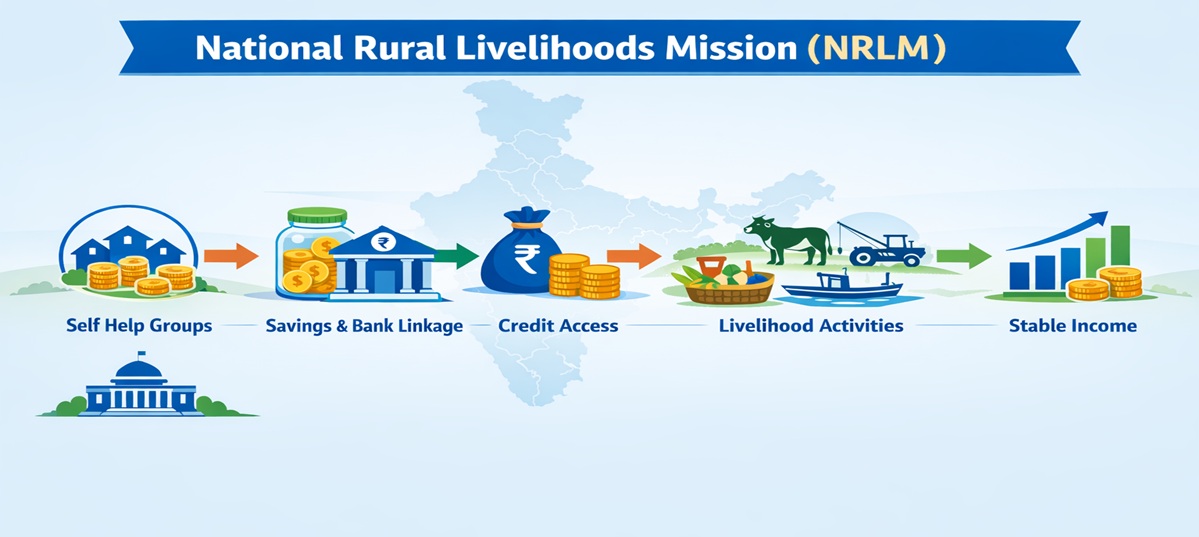
The National Rural Livelihoods Mission (NRLM) is a nationwide rural development initiative of the Government of India that focuses on improving income stability for poor rural households through organised community systems. The mission works by building strong local institutions, expanding access to finance, and supporting livelihood activities that are rooted in local economic conditions.
NRLM is not designed as a short-term assistance programme. Its structure reflects the understanding that rural poverty is shaped by long-term constraints such as irregular employment, low savings, limited skills, and weak market access. By addressing these factors together, NRLM aims to strengthen the economic capacity of rural households over time.
Officially known as Deendayal Antyodaya Yojana – National Rural Livelihoods Mission, the programme is implemented by the Ministry of Rural Development across all states and union territories.
Understanding the Need for National Rural Livelihoods Mission (NRLM)
In many parts of rural India, households depend on seasonal work, small landholdings, or informal labour markets. Income uncertainty often leads to debt cycles, reduced investment in livelihoods, and vulnerability during economic or environmental stress.
Earlier development efforts frequently focused on individual benefits without addressing the absence of collective support systems. The National Rural Livelihoods Mission (NRLM) was introduced to fill this gap by organising rural households into groups that could save together, borrow responsibly, and plan livelihoods collectively.
The programme recognises that access to institutions—banks, markets, training systems—is as important as income itself.
Guiding Principles of NRLM
The working philosophy of this rural livelihoods programme is based on practical field experience and long-term engagement.
Community Ownership
Institutions formed under NRLM are owned and managed by the community, not external agencies.
Women-Centred Institutions
Women form the majority of NRLM members, reflecting their role in household finance and livelihood decisions.
Graduated Support
Households receive support in stages, allowing skills and confidence to develop gradually.
Local Adaptation
Livelihood strategies are designed according to local resources, climate, and market conditions.
Institutional Structure of National Rural Livelihoods Mission (NRLM)
NRLM follows a multi-tier institutional framework that ensures coordination from policy level to village level.
National Level
The Ministry of Rural Development provides policy direction, financial norms, and national monitoring systems.
State Level
Each state operates NRLM through a State Rural Livelihoods Mission, adapting strategies to regional priorities.
District Level
District units coordinate implementation, training, and convergence with banks and other departments.
Block Level
Block teams offer technical support, supervision, and capacity building to Self Help Groups.
Village Level
Self Help Groups and their federations execute all programme activities.
Self Help Groups: The Core Units of NRLM
Self Help Groups are the foundation of the National Rural Livelihoods Mission (NRLM). Each group generally consists of 10 to 15 members, most often women, from similar economic backgrounds.
Functions of SHGs
Regular savings by members
Internal lending from pooled savings
Transparent record maintenance
Collective decision-making
Official government disclosures indicate that NRLM has mobilised more than 9 crore rural women into over 80 lakh Self Help Groups nationwide, making it one of the largest women-led financial networks globally.
Financial Inclusion Under NRLM
Financial inclusion is a central pillar of this community-based livelihoods framework. Many rural households previously relied on informal credit due to lack of access to banks.
Under NRLM:
SHGs open savings accounts with banks
Groups access credit without traditional collateral
Loan repayment responsibility is shared collectively
Financial literacy is promoted within groups
Available financial reports indicate that cumulative bank credit accessed by NRLM-linked SHGs has exceeded ₹7 lakh crore, highlighting the scale of institutional finance facilitated through community systems.
Livelihood Promotion Strategies
The National Rural Livelihoods Mission (NRLM) supports livelihoods that align with local economic conditions rather than prescribing uniform income activities.
Farm-Based Livelihoods
Crop cultivation and allied activities
Dairy, poultry, and livestock management
Fisheries and aquaculture
Non-Farm Livelihoods
Handloom and handicrafts
Food processing and small manufacturing
Local service enterprises
Skill and Wage-Based Livelihoods
Skill training for rural youth
Support for self-employment options
Wage-linked opportunities
This diversified strategy reduces dependence on a single income source.
Skill Development and Human Capital
Skill development under NRLM focuses on practical application and income relevance. Training programmes are aligned with local market demand rather than generic certification.
Participants receive training in:
Trade-specific technical skills
Enterprise planning and cost management
Financial literacy and bookkeeping
Leadership and communication
These skills strengthen both individual earning capacity and group functioning.
Role of Federations in NRLM
Beyond individual SHGs, NRLM promotes federations at village, cluster, and block levels.
Functions of Federations
Coordinating SHG activities
Supporting bulk procurement and marketing
Managing higher-level financial transactions
Representing community interests
Federations play a key role in scaling livelihood activities and ensuring continuity.
Market Linkages and Value Chains
One area often overlooked in NRLM discussions is market access. This national livelihoods initiative supports market linkages through producer groups, collective marketing, and value-chain development.
These efforts help reduce dependence on intermediaries and improve price realisation for producers.
Social Inclusion Framework
NRLM places focused attention on households facing social and economic disadvantage.
Priority groups include:
Scheduled Castes
Scheduled Tribes
Minority communities
Persons with disabilities
Inclusion is promoted not only through membership but also through leadership roles within institutions.
Monitoring, Data Systems, and Transparency
The National Rural Livelihoods Mission (NRLM) uses digital platforms to track group formation, savings, loans, training, and outcomes. Community-based monitoring complements digital systems.
Regular reviews and audits help maintain transparency and accountability.
Challenges and Ground-Level Realities
Despite its scale, NRLM faces operational challenges.
Common issues include:
Market access limitations in remote areas
Capacity gaps in newly formed groups
Need for sustained mentoring
Variations in banking outreach
These challenges underline the importance of continuous institutional strengthening.
Why National Rural Livelihoods Mission (NRLM) Remains Relevant
The National Rural Livelihoods Mission (NRLM) remains relevant because it builds systems rather than offering temporary assistance. Its emphasis on organisation, savings, diversified livelihoods, and financial inclusion strengthens resilience at the household and community levels.
Linkages With Other Rural Development Programmes
NRLM complements employment, housing, agriculture, and infrastructure programmes by preparing communities to engage effectively with available opportunities. Strong local institutions improve coordination and resource use.
Further Reading
NRLM complements other government initiatives that support rural households. While NRLM focuses on livelihoods and financial inclusion, schemes like Ayushman Bharat improve access to healthcare, helping families remain healthy and economically productive.
Ayushman Bharat PMJAY Scheme: Complete Guide — Benefits, Eligibility, and How to Apply
Ministry of Rural Development – NRLM Programme Overview
Frequently Asked Questions (FAQs)
1. What is the National Rural Livelihoods Mission (NRLM)?
The National Rural Livelihoods Mission (NRLM) is a Government of India programme that aims to reduce rural poverty by strengthening community institutions, improving access to finance, and supporting sustainable livelihood activities for poor rural households.
2. Who implements the National Rural Livelihoods Mission (NRLM)?
NRLM is implemented by the Ministry of Rural Development through State Rural Livelihoods Missions, with execution at district, block, and village levels.
3. Who are the main beneficiaries of NRLM?
The primary beneficiaries are poor rural households, especially women, including Scheduled Castes, Scheduled Tribes, minority communities, and other vulnerable groups.
4. What role do Self Help Groups play under NRLM?
Self Help Groups are the core units of NRLM. They promote regular savings, internal lending, financial discipline, and collective decision-making among members.
5. How does NRLM support financial inclusion?
NRLM enables Self Help Groups to open bank accounts, access collateral-free credit, improve financial literacy, and reduce dependence on informal moneylenders.
6. What types of livelihoods are supported under NRLM?
NRLM supports farm-based, non-farm, skill-based, and wage-linked livelihoods based on local resources, skills, and market conditions.
7. What is the role of federations in NRLM?
Federations coordinate SHG activities, support marketing and procurement, manage higher-level finances, and represent community interests at different administrative levels.
8. Why is NRLM considered a long-term rural development programme?
NRLM focuses on building institutions, skills, savings habits, and diversified livelihoods, which strengthens household resilience rather than providing short-term assistance.
9. How does NRLM promote social inclusion?
NRLM prioritises socially and economically disadvantaged groups and encourages their participation and leadership within community institutions.
10. How is transparency maintained under NRLM?
Transparency is ensured through digital monitoring systems, community-based reviews, regular audits, and structured reporting mechanisms.